
What is Google Ads business operations verification?
Business operations verification is a task within Google’s advertiser verification program. Google says most advertisers will not see it. When requested, it covers the organization, its products or services, its advertisements, and relationships with other organizations. Tasks depend on the account and billing setup.
Start in Admin → Policy → Account and read the exact request, account status, and deadline. Google says an account admin must complete the tasks. A request to explain operations, an identity-document task, and a payment-method check are different jobs. Record which one needs attention before collecting documents.
RID recommends assigning one coordinator and preserving the notice, previous answers, and any failure message. Give each contributor a specific question to resolve; avoid assembling a large folder before anyone knows what the reviewer needs to understand.
Why can different business names create confusion?
Google identifies insufficient relationship information as a verification problem. Its examples include agencies, a different domain owner, a different end provider, and other account participants. A company’s registration alone does not explain each of those connections.
Separate roles can be legitimate. The preparation challenge is to explain the arrangement accurately. A visitor might see a trading name, a contract might identify its legal operator, and an invoice might come from a fulfillment partner. An unexplained jump between them leaves a gap in the record.
Use one name consistently for each party in your working notes. Record alternate names beside it, rather than switching between abbreviations and brands as though they were separate businesses. Do not rename a real relationship merely to make the diagram simpler.
Build a business relationship map before gathering evidence
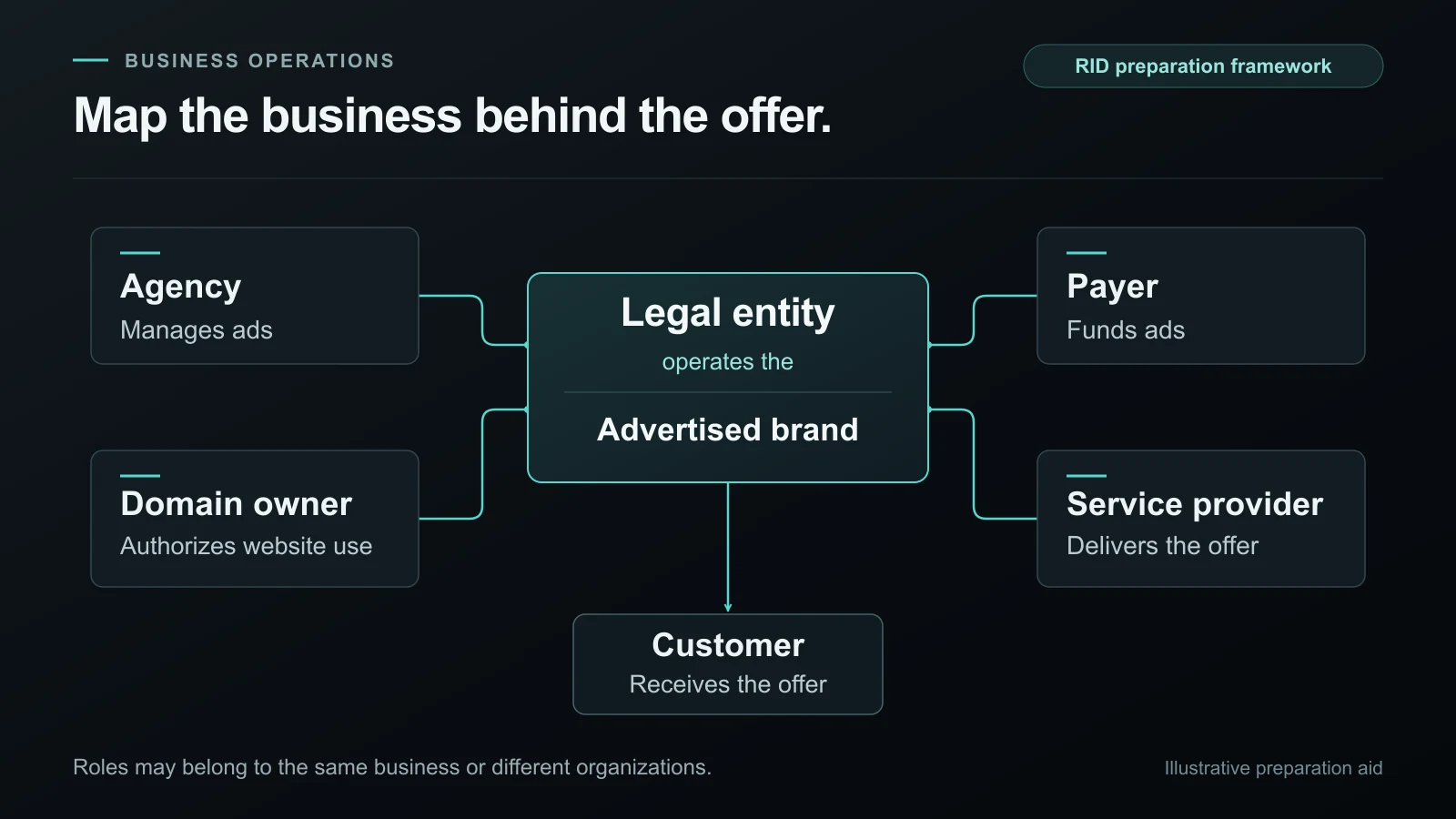
RID’s preparation framework starts with the offer a customer sees. Work backward from that offer to the businesses responsible for it. The diagram is an organizing aid, not an official Google form or a required business structure.
Put the legal operator and advertised brand in the center. Around them, add the agency, domain owner, payer, and delivery partner when those roles apply. One company may occupy several roles. A role can also involve more than one partner; name each relevant party instead of forcing the business into five boxes.
Write a verb on every connection: operates, manages, authorizes, funds, or delivers. Then ask a colleague unfamiliar with the account to explain the customer journey using only the map. Any unanswered question belongs in the evidence matrix.
- Start with the landing page and the specific product or service advertised.
- Identify the business the customer contracts with and the business fulfilling the promise.
- Add the account manager, domain relationship, and advertising-payment arrangement.
- Mark any connection you cannot yet substantiate. Assign an owner to resolve it.
RID’s evidence matrix: one relationship, one clear explanation
This matrix is a preparation framework, not a universal list of documents Google requires or accepts. The records below are examples to review internally. Submit only relevant evidence permitted by the current task.
For each row, record the exact names, the fact you need to establish, an evidence reference, and the person responsible. A useful evidence index explains what a file proves. It does not simply say “attached.”
Party or relationship
Brand and legal entity
- Question to settle
- Which legal business operates the advertised brand?
- Preparation record to review
- A name crosswalk linking the customer-facing name to its operator; relevant registration or trade-name records where applicable.
Agency and account access
- Question to settle
- Who manages the ads, and what is the scope of their authorization?
- Preparation record to review
- The client engagement and current account-access record. Separate campaign management from ownership of the advertised business.
Website and domain
- Question to settle
- Who owns or controls the domain, and why may this advertiser use it?
- Preparation record to review
- A domain/control record and the explanation of any owner–operator arrangement. Hosting access alone does not explain every relationship.
Service providers and partners
- Question to settle
- Who contracts with the customer, fulfills the offer, and handles problems?
- Preparation record to review
- A responsibility summary tied to the real supplier or partner arrangement, including who handles delivery, support, and refunds.
Payer
- Question to settle
- Who is charged for advertising, and how does that party relate to the advertiser?
- Preparation record to review
- A billing-flow summary distinguishing Google ad spend from agency fees and customer payments. Identify the relevant authorization.
Choose evidence for the connection you are explaining
Google’s relationship guidance gives examples such as agreements, letterhead explanations, invoices, and emails. Where those are unavailable, it describes using an identifier and verification website that can confirm the relationship. The relevance and substance of a record matter; no single example guarantees acceptance.
RID recommends an evidence note with four fields: relationship, factual explanation, record reference, and remaining question. For example: “Agency A manages campaigns for Business B. See the engagement scope and access record. Confirm whether the billing arrangement described there is still current.”
Keep distinctions visible. An invoice may show that one company billed another without explaining who serves the customer. A registration may identify a company without connecting it to the advertised brand. Resolve the missing connection instead of assuming another attachment will do it.
Example 1: an agency manages the account
Hypothetical example: Cedar Home Services sells and performs repair work. Beacon Media manages its campaigns. The client pays Google directly, and the agency separately invoices a management fee.
The working map names Cedar as the advertised service business and provider, Beacon as the ads manager, and Cedar as the advertising payer. It also records who controls the website. The explanation should not imply that Beacon performs the repairs just because its staff access Google Ads.
If Beacon instead pays Google and recharges the client, the payer row changes. The team needs an accurate account of that arrangement; it should not silently describe client-direct billing. Google’s agency guidance requires an agency managing client ads to identify itself as an agency.
Preparation question: can the owner, agency, and billing contact each describe the same arrangement without contradicting one another?
Example 2: the brand differs from the legal company
Hypothetical example: Harbor Desk is the name customers see, while North Quay Interiors LLC operates the business, signs customer contracts, and appears on registration records.
The preparation record explicitly connects Harbor Desk to North Quay Interiors LLC. It identifies the real basis for using the brand and checks whether customer-facing information explains who the business is. A trade-name filing may be relevant where one exists; do not invent a filing or assume every location uses the same registration system.
Use the name appropriate to the question being asked. If a field asks for the legal entity, provide that entity’s legal name rather than assuming the customer-facing brand belongs there. Copying the shorter brand into every field may create a new inconsistency.
Preparation question: can someone move from the ad to the website to the contracting company without having to guess that two names refer to the same operation?
Example 3: another business delivers the service
Hypothetical example: Summit Booking markets appointments and takes customer enquiries. Independent providers perform the on-site work. The critical question is what Summit promises, what it actually does, and what the provider is responsible for.
Draw the customer journey: enquiry, booking, payment, delivery, support, and any refund. Name the responsible business at each step. If the customer contracts directly with a provider, distinguish that from a model where Summit sells the service and subcontracts delivery.
Review the actual partner arrangement alongside the landing page. A statement that “our team delivers every service” needs attention if the business instead introduces customers to independent providers. Correct factual descriptions; do not invent a closer relationship or remove relevant facts simply to make the account easier to explain.
Preparation question: does the explanation identify the seller, the delivery business, and the route a customer uses if something goes wrong?
What should you review after failed verification?
Start with the failure reason Google provides. Do not assume that every unsuccessful task has the same hidden cause. RID recommends a short gap review before another submission.
Google warns that excessive unsuccessful verification attempts can lead to an account pause. Repeatedly sending the same unexplained material is not a substitute for addressing the stated problem.
- Preserve the previous submission and the complete response. Record the task and affected account.
- Locate the specific unanswered question: identity, relationship, provider, document quality, or another stated issue.
- Compare the relevant form answer with the account, website, and supporting record. Describe the discrepancy precisely.
- Resolve the factual gap and check the permitted document type, completeness, current regional requirements, and any applicable licenses requested for a regulated service.
- Have the account admin review the corrected explanation and follow the account’s available resubmission or support route. Save the new version and confirmation.
Handle verification documents securely
Google’s document guidance says to submit requested documents through the Google Ads interface, not email, and not to combine multiple advertisers’ documents into one file. Accepted evidence depends on the task, country, and account type; follow the applicable instructions.
Google’s business-relationship guidance permits hiding unrelated proprietary or personal information. Do not obscure the details needed to substantiate the relationship or satisfy the specific identity-document request.
For internal preparation, RID recommends a restricted evidence folder and a separate index containing document descriptions and references. Keep identity documents, full payment details, and signed agreements out of public website uploads, general chat channels, and unrestricted shared folders.
Retain an original and clearly label any permitted redacted copy. Assign one person to check the final files and recipients. Do not alter facts, manufacture an agreement, or ask a partner to certify something untrue.
Does passing verification reinstate a suspended account?
No. Google may require successful verification before a suspended advertiser can access the appeal process. Completing that task is not itself a successful suspension appeal.
For an account paused for business operations verification, Google says ads can resume after successful review if they comply with its policies. A separate suspension needs its own resolution. Check the actual account status rather than treating a verification confirmation as permission to resume spend.
If an appeal is already pending, keep verification updates in the same working history and follow the instructions associated with that case.
RID Marketing · Verification review
Get the business explanation clear before the next submission
Bring the notice, previous answers, relationship map, and a short list of unresolved connections to a review. You can describe the documents you hold before sharing sensitive copies.
Randall Kreiser is the founder of RID Marketing. If your agency, brand, payer, or delivery partners are difficult to explain, contact RID to discuss the scope of an account and verification review. RID is independent from Google; Google controls verification and reinstatement decisions.
Common questions.
Does every advertiser have to complete business operations verification?
No. Google’s current task guidance says most advertisers will not see this particular task. Follow the verification tasks actually assigned to your account.
Can the agency, advertiser, and payer be different businesses?
Google’s task guidance accommodates agency and client arrangements. Explain who performs each role and answer the account’s questions accurately. Do not change the payer merely to make the names look identical.
Is there one document that proves the whole business model?
RID recommends matching each record to a specific fact. A company registration, for example, does not by itself explain every agency, domain, payment, or fulfillment relationship.
What if I cannot document a relationship?
Identify the missing fact and consult the task’s instructions before submitting. Do not invent evidence or claim a relationship is verified because someone verbally assured you it was.
Will this matrix guarantee verification?
No. It is RID’s preparation aid. Google evaluates the actual task, business information, and evidence; a completed worksheet does not establish acceptance or reinstatement.
Go to the source
Official policies & guidance.
Google’s requirements are linked below. The review steps on this page are RID Marketing’s practical guidance, not an exhaustive Google checklist. Sources checked November 17, 2026; follow any newer instructions in your account.
- Google Ads advertiser verification tasks (opens in a new tab)
- Google Ads business operations verification troubleshooting (opens in a new tab)
- Google Ads account pausing (opens in a new tab)
- Google Ads advertiser verification documents (opens in a new tab)
- Google Ads account suspensions overview (opens in a new tab)